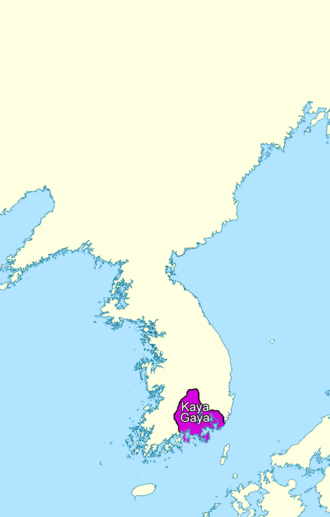
“Between the great kingdoms of Silla, Baekje, and Goguryeo, there existed a fourth power — one whose mastery of iron shaped the destiny of the entire peninsula.”
When most people think of Korea’s ancient kingdoms, they picture the celebrated Three Kingdoms: Goguryeo in the north, Baekje in the southwest, and Silla in the southeast. Yet nestled in the fertile river valleys of what is now South Korea’s Gyeongsang region, a fourth political entity flourished for over five centuries — the Kaya Confederacy. Often called the “forgotten kingdom,” Kaya (also romanized as Gaya) was not a unified monarchy but a loose alliance of city-states bound together by shared culture, trade networks, and an extraordinary command of iron technology. Its story is one of resilience, artistry, and ultimately, absorption — yet its legacy quietly runs through the veins of Korean civilization to this day.
Quick Facts: The Kaya Confederacy at a Glance
| Fact | Detail |
|---|---|
| Period | Approximately 42 CE – 562 CE |
| Location | Southern Korean peninsula, centered around the Nakdong River basin |
| Capital (principal state) | Geumgwan Kaya (present-day Gimhae) |
| Political structure | Confederacy of semi-independent chiefdom-states |
| Key resource | Iron ore and advanced iron production |
| Major trading partners | Wa (Japan), Lo-lang (China), Baekje, Silla |
| Absorbed by | Silla (final annexation in 562 CE) |
| Modern location | Gyeongnam and Gyeongbuk provinces, South Korea |
Origins: How Did the Kaya Confederacy Begin?
The origins of Kaya are intertwined with legend and early historical record. According to the Samguk Yusa (Memorabilia of the Three Kingdoms), the foundational myth tells of six eggs descending from the heavens onto Mount Guji in the Gimhae region. From these eggs, six boys were born, the eldest of whom became King Suro — the legendary founder of Geumgwan Kaya, the most powerful of the Kaya states. While the mythological framing is characteristic of ancient Korean foundation narratives, archaeological evidence confirms that politically organized communities were well established in the Nakdong River basin by the early centuries of the Common Era.
The confederacy was never a centralized state with a single ruler commanding all member polities. Instead, it operated as a network of allied chiefdoms and small kingdoms, each maintaining its own leadership while cooperating in trade, defense, and cultural exchange. The principal member states included Geumgwan Kaya (also called Bon Kaya), Daegaya, Ara Kaya, Sogaya, Seongsan Kaya, and Goryeong Kaya, each positioned along tributaries and lowlands of the Nakdong River system.
This decentralized structure was both a strength and a vulnerability. It allowed individual states to adapt and thrive in their local environments, but it also prevented the kind of unified military mobilization that ultimately allowed Silla to dominate the peninsula.
The Iron Advantage: Why Kaya Mattered to Ancient East Asia
If there is one reason that Kaya punched above its political weight for so long, it was iron. The region sat atop some of the richest iron ore deposits on the Korean peninsula, and Kaya craftsmen developed smelting and forging techniques that were among the most advanced in East Asia at the time. Kaya iron was not merely a local commodity — it was a sought-after export that powered trade networks stretching to the Japanese archipelago and the Chinese commanderies of the north.
“Kaya’s iron ingots functioned almost like a currency across early East Asia — they were so standardized and reliable that Chinese historical texts specifically noted their use as trade goods.”
Chinese records, including passages in the Wei Zhi (Chronicle of Wei), describe the Byeonhan people — the pre-confederacy inhabitants of the Kaya region — as producing iron that was traded to the Han commanderies in the north and to the Wa kingdoms of what is now Japan. Kaya iron ingots, sometimes called deopse (판상철부), have been recovered from archaeological sites across the Korean peninsula and in Japan, confirming the wide reach of this trade.
The iron industry supported not only weapons production but also agricultural tools, which contributed to the region’s agricultural productivity and population growth. Kaya’s access to iron gave it a degree of economic independence that allowed it to survive even when the larger kingdoms of the peninsula were at war around it.
3 Defining Characteristics of Kaya Civilization
1. Masterful Iron Craftsmanship
Kaya smiths produced a remarkable range of iron goods, from agricultural implements and fishing tools to elaborate suits of iron armor and finely forged swords. Excavations at Kaya burial mounds — particularly in the Gimhae and Haman areas — have uncovered iron armor, helmets, and weapons of extraordinary quality. These artifacts, now displayed in South Korean national museums, demonstrate a level of metallurgical sophistication comparable to anything being produced in East Asia at the time. The tradition of iron craftsmanship that Kaya exported to the Wa kingdoms of Japan is believed to have contributed significantly to the development of Japanese sword-making traditions.
2. A Vibrant Maritime Trade Network
Positioned along the southern coast of the peninsula, Kaya — particularly the port-state of Geumgwan Kaya near the mouth of the Nakdong River — was ideally placed for maritime commerce. The waters between southern Korea and northern Kyushu in Japan were not a barrier but a highway. Archaeological evidence recovered from Kaya sites includes pottery styles that show clear parallels with contemporaneous Japanese Yayoi culture, and Japanese sites have yielded Kaya-style artifacts including iron ingots, bronze mirrors, and distinctive earthenware. This cross-sea exchange was not merely economic; it was cultural and, some scholars argue, demographic, with possible population movements between the peninsula and the archipelago during this era.
3. Distinctive Earthenware and Burial Culture
Kaya is celebrated among archaeologists for its distinctive gray stoneware, known as gaya togi. Fired at high temperatures, these vessels — cups, jars, bowls mounted on intricate stands — display a refined aesthetic that is immediately recognizable and distinct from the pottery traditions of Silla or Baekje. Equally revealing are Kaya’s burial practices. The elite were interred in large tumuli (burial mounds) containing not only weapons and tools but also ritual objects, horse gear, and even evidence of accompanying burials, suggesting a hierarchical society with complex beliefs about the afterlife and the status of its ruling class.
Kaya vs. Its Neighbors: A Political Comparison
| Feature | Kaya | Silla | Baekje |
|---|---|---|---|
| Political structure | Loose confederacy | Centralized monarchy | Centralized monarchy |
| Key resource | Iron | Agriculture, gold | Agriculture, trade |
| Major external ties | Wa (Japan), China | Tang China (later) | Japan, China |
| Writing system | None confirmed | Chinese characters (Hanja) | Chinese characters (Hanja) |
| Fate | Absorbed by Silla (562 CE) | Unified peninsula (668 CE) | Conquered by Silla/Tang (660 CE) |
The Slow Decline: How Kaya Was Lost to History
Kaya’s eventual disappearance was not the result of a single catastrophic military defeat but rather a prolonged process of political erosion. The confederacy’s decentralized nature, while allowing flexibility, made it difficult to mount a coordinated response to the growing power of Silla to the east. Beginning in the 4th century, Kaya faced increasing military pressure. A pivotal blow came in 400 CE when Goguryeo, at the request of Silla, sent a large army south that decisively weakened Geumgwan Kaya. This campaign effectively ended the dominance of the western coastal state within the confederacy and shifted the center of Kaya power eastward to Daegaya, based in present-day Goryeong.
Under Daegaya’s leadership, the confederacy experienced a cultural renaissance in the 5th and early 6th centuries. Daegaya expanded its diplomatic reach, sending envoys to Southern Qi (China) in 479 CE and forging alliances with Baekje. The famous musician Ureuk, who developed the gayageum — the twelve-stringed zither that remains one of Korea’s most iconic traditional instruments — served at the Daegaya court, a testament to the cultural vitality of this final Kaya flourishing.
Yet diplomacy and culture could not substitute for military unity. Silla methodically absorbed the smaller Kaya polities throughout the 6th century. The western states fell first. Geumgwan Kaya submitted to Silla in 532 CE. Daegaya, the last major holdout, fell in 562 CE when Silla general Isabu led a campaign that ended the confederacy’s independent existence. The Kaya elites were not exterminated; many were absorbed into Silla’s aristocratic bone-rank system, and their cultural traditions continued to influence the unified kingdom. But as a political entity, Kaya was gone.
Why Does Kaya Matter Today?
For much of the 20th century, Kaya received comparatively little attention in the study of Korean history, overshadowed by the dramatic narrative of the Three Kingdoms and the eventual unification under Silla. This began to change as systematic archaeological work from the 1970s onward revealed the extraordinary richness of Kaya material culture. Major excavation sites in Gimhae, Haman, Goryeong, and Changnyeong produced thousands of artifacts that demonstrated Kaya’s sophistication and its wide-ranging connections across East Asia.
In 2023, a cluster of Kaya tumuli sites — including burial mound complexes in Gimhae, Haman, Goryeong, Hapcheon, Changnyeong, and Namyangju — achieved UNESCO World Heritage status under the collective inscription “Gaya Tumuli.” This recognition placed Kaya’s burial culture among the world’s acknowledged outstanding universal values, giving the forgotten confederacy a long-overdue place on the global heritage stage. The UNESCO inscription highlighted the tumuli’s testimony to the unique political and cultural character of Kaya as a non-centralized peer polity that nonetheless produced a sophisticated and distinctive civilization.
The gayageum — that elegant twelve-stringed zither whose invention is credited to the Daegaya court musician Ureuk — continues to be played in Korea today, its resonant tones a living thread connecting modern Koreans to the world of Kaya. Every time a musician plucks its strings in a concert hall or a classroom, the memory of the iron kingdom at the heart of the ancient peninsula is, in some small way, preserved.
Continue Exploring
On Coreaverse
- The Three Kingdoms of Korea: Goguryeo, Baekje, and Silla
- The Gayageum: Music Born in a Forgotten Kingdom
- Gaya Tumuli: Korea’s Newest UNESCO World Heritage Site