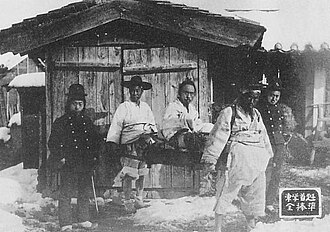
“We rise not to overthrow, but to save the people and secure the nation.” — The spirit of the Tonghak peasant leaders, 1894
In the spring of 1894, tens of thousands of Korean farmers, artisans, and disaffected commoners took up arms across the Jeolla province of the Joseon dynasty. What began as a local protest against corrupt officials quickly transformed into one of the most significant popular uprisings in Korean history. The Tonghak Peasant Revolution — known in Korean as the Donghak Nongmin Hyeongmyeong — was not merely a rebellion. It was a cry for justice from the bottom of Korean society, and its consequences rippled outward to reshape the entire East Asian geopolitical order.
The revolution drew its name from the Tonghak (Eastern Learning) religious and social movement, a uniquely Korean ideology that blended Confucian, Buddhist, and shamanist thought with a fierce rejection of Western and Japanese encroachment. Its followers believed in the equality of all people before Heaven — a radical idea in a society still structured around rigid aristocratic hierarchies. By 1894, these beliefs had fused with desperate economic grievances to ignite a firestorm that the Joseon court could not contain alone.
Quick Facts: The Tonghak Peasant Revolution
| Date | January – December 1894 |
|---|---|
| Location | Joseon Korea, primarily Jeolla and Chungcheong provinces |
| Key Leaders | Jeon Bong-jun, Kim Gae-nam, Son Byong-hui |
| Ideology | Tonghak (Eastern Learning) — equality, anti-corruption, anti-foreign intervention |
| Opposing Forces | Joseon royal army, Chinese Qing forces, Japanese Imperial forces |
| Outcome | Revolution suppressed; triggered the First Sino-Japanese War (1894–1895) |
| Legacy | Inspired later Korean independence movements; recognized as a foundational democratic struggle |
What Was the Tonghak Movement, and Why Did It Explode in 1894?
To understand the revolution, one must first understand the Tonghak faith. Founded in 1860 by Choe Je-u, Tonghak emerged as a direct response to the perceived threat of Western Christianity — called Seohak, or Western Learning — and to the social injustices embedded in late Joseon society. Choe Je-u taught that the divine was present in every human being, making all people fundamentally equal. This was a message with explosive potential in a Korea where yangban (aristocratic) families monopolized power and commoners bore crushing tax burdens.
Choe Je-u was executed by the Joseon government in 1864, branded a dangerous heretic. But his movement did not die with him. Under the second patriarch, Choe Si-hyeong, Tonghak spread quietly through the countryside, especially among the poor farming communities of the southwest. By the early 1890s, Tonghak followers had grown bold enough to stage public petitions demanding the rehabilitation of their founder’s name and the recognition of their faith.
Meanwhile, the structural conditions for revolt were worsening rapidly. The late Joseon government was riddled with corruption. Local magistrates routinely imposed illegal taxes and seized land from farmers who could not pay. The national treasury was depleted. Foreign goods — especially cheap Japanese textiles — were undercutting Korean artisans and merchants. A series of poor harvests had pushed farming families to the edge of starvation. When the corrupt magistrate Jo Byong-gap of Gobu County began demanding unpaid labor and extorting farmers in Jeolla province in late 1893, it provided the final spark.
Three Phases That Defined the Revolution
1. The Gobu Uprising and First Advance (January–May 1894)
In January 1894, Jeon Bong-jun — a local Tonghak leader who would become the revolution’s most celebrated figure — led a group of farmers in storming the Gobu government office. They freed prisoners, redistributed stockpiled grain to the poor, and destroyed the hated irrigation reservoirs that had been built through forced peasant labor. The government’s response was brutal and incompetent in equal measure: rather than addressing the farmers’ grievances, an investigator was sent who only made conditions worse, arresting innocent people and burning homes.
This heavy-handed reaction drove thousands more into the rebel camp. By April, the Tonghak army — now a genuine military force — had won a stunning victory at the Battle of Hwangnyonggye and captured the city of Jeonju, the provincial capital of Jeolla. The Joseon court was in panic.
2. The Jeonju Agreement and Uneasy Peace (May–September 1894)
Faced with a rebellion it could not crush militarily, the Joseon government agreed to negotiate. In late May 1894, representatives of the court and the Tonghak army signed the Jeonju Agreement. The rebels agreed to stand down in exchange for a promise of reform, including the establishment of local governance councils called jipgangsо that would allow commoners a voice in local administration — a remarkable concession in a Confucian monarchy.
However, the Joseon court had already made a fateful decision: it had requested military assistance from Qing China to help suppress the uprising. Under the terms of the 1885 Convention of Tientsin, China was obligated to notify Japan of any troop deployment to Korea. Japan, viewing Korea as within its own sphere of interest, immediately dispatched its own forces. Even as the Jeonju Agreement brought a temporary halt to the rebellion, foreign troops were converging on Korean soil.
“The peasants sought reform from within the Joseon system. It was the foreign response to their revolt that broke Korea open to a new and devastating era.”
3. The Second Rising and Final Defeat (September–December 1894)
When Japanese troops seized the Joseon royal palace in July 1894 and installed a pro-Japanese government, the Tonghak leadership recognized that a new and greater threat had arrived. Jeon Bong-jun called for a second mobilization — this time explicitly framed as a patriotic, anti-Japanese struggle as much as an anti-corruption one. Tens of thousands responded, but the Tonghak forces were now fighting a modern, well-equipped Japanese Imperial Army rather than the undermanned Joseon constabulary.
The decisive engagement came at the Battle of Ugeumchi in November 1894. Equipped largely with traditional weapons and crude firearms, the Tonghak army launched wave after wave of assaults against entrenched Japanese and Joseon government positions. They were mowed down by modern rifles and Gatling guns. Casualty estimates for the broader suppression campaign run into the tens of thousands. Jeon Bong-jun was captured in December 1894 and executed in Seoul the following year.
How Did the Revolution Change Korean and East Asian History?
The immediate military outcome was unambiguous: the Tonghak Peasant Revolution was crushed. But its consequences were vast and enduring.
Most directly, the presence of both Chinese and Japanese troops on Korean soil — invited and prompted by the crisis of the rebellion — provided the trigger for the First Sino-Japanese War (1894–1895). Japan’s decisive victory in that conflict effectively ended Chinese suzerainty over Korea and opened the path toward Japan’s eventual annexation of the peninsula in 1910. In this grim sense, the revolution’s failure accelerated Korea’s colonial tragedy.
Yet the revolution also planted seeds that would flower decades later. The Tonghak movement itself survived the suppression, reorganizing in the early twentieth century as the Cheondogyo religion, which played a central role in the March 1st Independence Movement of 1919. The spirit of popular sovereignty that animated the 1894 uprising — the belief that ordinary Koreans had the right to demand justice from those in power — became a recurring theme in the long struggle for Korean independence and democracy.
In modern South Korea, the Tonghak Peasant Revolution is officially remembered as a foundational democratic event. The Donghak Peasant Revolution Memorial Hall in Jeongeup, Jeolla province, commemorates the uprising and honors its fallen participants. Streets, schools, and cultural institutions across Korea bear the names of its leaders.
Jeon Bong-jun: Hero, Rebel, and Martyr
No figure embodies the revolution more completely than Jeon Bong-jun (1855–1895), known to later generations by his nickname Nok-du (Green Bean) — a humble name that suited the man who led the humble. A middle-class farmer and local Tonghak official from Gobu, Jeon was not a military man by training. He became one by necessity.
After his capture, Jeon was transported to Seoul, where he was interrogated and eventually tried. Contemporary accounts record that he refused to beg for mercy or recant his actions, insisting that he had acted in the interests of the Korean people. He was executed on 24 March 1895. His defiance in defeat only enhanced his legendary status among later generations of Koreans who saw in him a model of principled resistance against both domestic corruption and foreign domination.
A Comparison: Tonghak Goals vs. Actual Outcomes
| Tonghak Demand | Short-Term Outcome (1894–1895) | Long-Term Legacy |
|---|---|---|
| End of corrupt local governance | Partial reforms promised; Gabo Reforms (1894) followed | Inspired later democratic governance ideals |
| Equality for commoners | Some legal class distinctions abolished in Gabo Reforms | Foundation for modern Korean democratic values |
| Expulsion of Japanese influence | Japan’s influence dramatically increased | Resistance spirit carried into independence movement |
| Recognition of Tonghak faith | Suppressed; leaders executed | Cheondogyo religion survived; active in 1919 uprising |
| Relief from illegal taxation | Temporary local relief; systemic change limited | Peasant grievances remained a political issue for decades |
Why the Tonghak Revolution Still Matters Today
More than 130 years after the first farmers marched on the Gobu government office, the Tonghak Peasant Revolution continues to resonate in Korean public life. Scholars debate its precise character — was it primarily a religious movement, a class struggle, a proto-nationalist uprising, or all three? The answer is probably all three, which is precisely what makes it so remarkable and so difficult to reduce to a single narrative.
What is not in debate is its emotional and symbolic power. When South Korean citizens took to the streets during the pro-democracy movements of the 1980s, when candlelight vigils filled Seoul’s Gwanghwamun Square in the 2010s, commentators repeatedly drew lines of descent back to the spirit of 1894. The idea that the Korean people have not only the right but the duty to demand honest and just governance from their leaders — that idea has deep roots, and many of those roots reach back to a group of farmers in Jeolla province who refused, one more time, to accept what they were told to accept.
The Tonghak Peasant Revolution is a story of defeat. It is also, in the most important ways, a story that has never quite ended.
Continue Exploring
On Korea Through Time
- The Joseon Dynasty: Five Centuries of Korean Civilization
- The March 1st Movement: Korea’s Declaration of Independence
- The Gabo Reforms: Modernization in the Shadow of Revolution