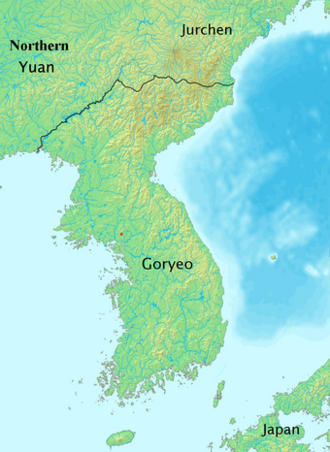
“From the peaks of Mount Songak to the shores of the Yellow Sea, Goryeo stood as one of the most sophisticated civilizations of the medieval world — a kingdom of celadon, sutras, and steel.”
When the English word “Korea” is spoken anywhere in the world today, it carries within it the echo of a dynasty that ruled the Korean peninsula for nearly five centuries. The Goryeo kingdom, which flourished from 918 to 1392 CE, was not merely a medieval state — it was a cultural powerhouse that produced extraordinary achievements in art, religion, technology, and governance. From the delicate jade-green hues of its celadon pottery to the millions of woodblocks carved to preserve Buddhist scripture, Goryeo left a legacy that still defines Korea in the global imagination.
Quick Facts: The Goryeo Kingdom at a Glance
| Detail | Information |
|---|---|
| Official Name | Goryeo (고려) |
| Period | 918 – 1392 CE |
| Founded by | Wang Geon (King Taejo) |
| Capital | Gaegyeong (modern Kaesong, North Korea) |
| Dominant Religion | Buddhism |
| Preceded by | Later Three Kingdoms period |
| Succeeded by | Joseon dynasty (founded 1392) |
| Name Origin | Source of the English word “Korea” |
How Did Wang Geon Unite a Fractured Peninsula?
The story of Goryeo begins in a period of violent fragmentation. By the early tenth century, the once-mighty Silla dynasty had collapsed into chaos, its authority undermined by powerful regional lords and a series of peasant uprisings. The peninsula had fractured into what historians call the Later Three Kingdoms — a brutal contest of power between Silla, Later Baekje, and a new northern state called Taebong, later renamed Majin, ruled by the warlord Gung Ye.
It was from within Gung Ye’s court that Wang Geon emerged. A skilled military commander of aristocratic stock, Wang Geon eventually overthrew his erratic and increasingly tyrannical master in 918 CE and founded his own dynasty, which he named Goryeo — a deliberate invocation of the ancient Goguryeo kingdom that had once dominated northern Korea and Manchuria. This name was a political statement as much as a historical reference: Wang Geon claimed the mantle of a reunified, powerful Korean state.
His strategy of unification was notable for its relative restraint. Rather than simply conquering rivals, Wang Geon — posthumously honored as King Taejo, or “Grand Progenitor” — pursued strategic marriages, forming alliances with regional aristocratic families across the peninsula. He accepted the peaceful surrender of the last Silla king in 935 CE, and by 936 CE had defeated Later Baekje to complete the unification of the peninsula. His Ten Injunctions, a set of political and moral guidelines left for his successors, reveal a ruler deeply concerned with the stability and moral foundations of his new state, emphasizing reverence for Buddhism, care for the people, and caution toward Manchurian influences.
3 Defining Achievements of the Goryeo Dynasty
1. The World’s First Metal Movable Type
One of the most remarkable technological feats of the medieval world was accomplished not in Europe but in Korea. Goryeo craftsmen developed metal movable type printing technology, a full two centuries before Johannes Gutenberg’s famous press transformed Europe in the 1450s. While Goryeo’s system was used primarily for printing Buddhist texts and government documents rather than for mass public communication, the ingenuity of the technology is undeniable. Books printed with Goryeo’s metal type survive to this day, silent witnesses to a sophisticated printing culture that the world has not always adequately credited.
2. The Tripitaka Koreana — A Monument in Wood
Perhaps no single object captures the ambition and devotion of Goryeo civilization more completely than the Tripitaka Koreana. Carved onto more than 81,000 wooden printing blocks, this complete collection of Buddhist scriptures represents one of the most extraordinary feats of human scholarship and craftsmanship in history. The project was undertaken twice — the first set of blocks was destroyed during the Mongol invasions of the thirteenth century, and the Goryeo court commissioned a second, even more meticulous set, completed in 1251, as a spiritual appeal for divine protection against the invaders. The surviving blocks, housed at Haeinsa Temple in South Gyeongsang Province, are a UNESCO World Heritage site, recognized for their remarkable accuracy and preservation.
3. Goryeo Celadon — Beauty in Blue-Green
Among the artistic triumphs of the Goryeo period, celadon ceramics hold a place of particular distinction. Goryeo potters developed and refined a style of celadon — characterized by its luminous jade-green glaze — that was admired across East Asia and remains one of the most celebrated ceramic traditions in world art history. What made Goryeo celadon distinctive was not merely the color of its glaze but the technique of sanggam, or inlaid decoration, in which designs were carved into the clay surface, filled with white or black slip, and then covered with the translucent glaze. The result was pottery of breathtaking elegance: cranes floating through clouds, willows bending over water, flowers blooming across the curved surfaces of bottles and bowls. Chinese envoys who visited Goryeo marveled at the quality of these wares, and modern collectors and museum curators around the world prize surviving examples as masterpieces.
“Goryeo celadon so entranced Chinese observers that one Song dynasty official described its color as ‘the first under heaven’ — a remarkable compliment from the cultural capital of the medieval world.”
Buddhism, Confucianism, and the Soul of Goryeo
If one wishes to understand the inner life of Goryeo civilization, one must begin with Buddhism. From the dynasty’s very foundation, Buddhism was enshrined as the state religion, lavishly patronized by the royal court and deeply embedded in the daily lives of the people. Monasteries were not merely places of worship; they were centers of learning, art production, and economic activity. The great Buddhist monk Uicheon, a royal prince who became one of the most influential religious figures of the era, traveled to China to study and returned to attempt a synthesis of competing Buddhist schools — a project that reflected the intellectual vitality of Goryeo’s religious culture.
Yet Goryeo was never solely a Buddhist state. The dynasty also developed a sophisticated Confucian bureaucracy, establishing the Gukjagam — a national academy — and implementing civil service examinations modeled on Chinese practice. These examinations theoretically opened government positions to men of talent regardless of birth, though in practice the aristocratic class known as the munbeol retained enormous influence. This tension between meritocratic ideals and entrenched aristocratic power would remain a defining feature of Goryeo governance throughout the dynasty’s life.
Invasion, Resistance, and the Mongol Century
The thirteenth century brought catastrophe to Goryeo in the form of the Mongol Empire. Beginning in 1231, Mongol armies launched a series of devastating invasions of the Korean peninsula. The Goryeo court, seeking to preserve its existence, made the controversial decision to relocate from the capital Gaegyeong to the island of Ganghwa, off the western coast. This move allowed the royal family and court to survive — the Mongols lacked a strong naval tradition — but it left the mainland population exposed to decades of brutal occupation and destruction.
The resistance of the Goryeo people during this period was extraordinary. It was precisely during the Mongol invasions that the second carving of the Tripitaka Koreana was undertaken — a massive, decades-long project motivated in part by the belief that the accumulated merit of such devotion might bring divine intervention against the invaders. It did not end the invasions, but it produced one of humanity’s greatest cultural artifacts.
Eventually, Goryeo was forced to submit to Mongol suzerainty, becoming a vassal state of the Yuan dynasty. Goryeo kings married Mongol princesses; Mongol influence penetrated the court deeply. Yet Goryeo retained its royal line and its cultural identity even through this difficult century, and when the Yuan dynasty collapsed in the mid-fourteenth century, Goryeo briefly reasserted its independence before internal political struggles led to its replacement by the new Joseon dynasty in 1392.
Why Does Goryeo Still Matter Today?
The legacy of Goryeo is woven into the fabric of Korean identity in ways that are both obvious and subtle. Most visibly, the very name by which Korea is known to the world — in English, French, German, Spanish, and dozens of other languages — derives directly from “Goryeo.” Every time someone says “Korea,” they are unknowingly invoking this medieval dynasty.
Beyond the name, Goryeo’s contributions to world culture are significant and enduring. The Tripitaka Koreana at Haeinsa Temple, designated a UNESCO World Heritage site along with the temple complex that houses it, stands as one of the great achievements of human civilization. Goryeo celadon pieces occupy honored places in the world’s finest museums. And the dynasty’s pioneering work in printing technology represents a chapter in the global history of knowledge transmission that deserves far greater recognition than it typically receives in Western-centered accounts of the history of print.
Goryeo also established political and cultural patterns — the synthesis of Buddhism and Confucian governance, the tension between royal authority and aristocratic power, the capacity for cultural creativity even under existential pressure — that would shape the succeeding Joseon dynasty and, through it, many aspects of Korean society that persist to the present day.
Continue Exploring
On This Site
- Haeinsa Temple and the Tripitaka Koreana: Korea’s Sacred Wooden Library
- Goryeo Celadon: The Jade-Green Art That Amazed the World
- The Joseon Dynasty: Confucian Korea’s Five-Century Experiment