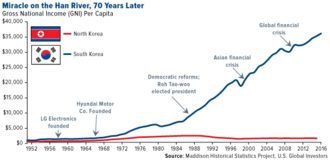
“In a single generation, South Korea rose from the ashes of war to become one of the most dynamic economies on earth — a transformation the world came to call the Miracle on the Han River.”
Few economic stories in modern history are as dramatic or as instructive as the rise of South Korea. In the early 1950s, the Korean War left the peninsula in ruins. Cities were reduced to rubble, infrastructure was shattered, and millions of Koreans faced grinding poverty. By the late twentieth century, however, South Korea had become the world’s eleventh-largest economy, a global leader in shipbuilding, electronics, and automotive manufacturing, and a model that developing nations around the world sought to emulate. This extraordinary transformation carries a poetic name: the Miracle on the Han River — a reference to the Han River that flows through the heart of Seoul, the capital city that became the engine of the nation’s growth.
Understanding how this miracle happened — and what it cost — remains essential for anyone seeking to understand modern Korea and its place in the world.
Quick Facts: The Miracle on the Han River
| Category | Details |
|---|---|
| Period | Roughly 1960s–1990s (peak growth era) |
| Starting point | Post-Korean War devastation; one of Asia’s poorest nations |
| Key leaders | Park Chung-hee (president 1963–1979) and successive governments |
| Economic model | Export-led industrialization, state-directed capitalism |
| Major industries | Steel, shipbuilding, electronics, automobiles, textiles |
| Key institutions | Chaebol conglomerates (e.g., Samsung, Hyundai, LG) |
| GDP growth | Averaged nearly 10% per year during peak decades |
| Name origin | Inspired by West Germany’s “Miracle on the Rhine” |
From War Ruins to Industrial Ambition
When the Korean War armistice was signed in 1953, South Korea was devastated. The country’s per capita income was among the lowest in Asia — comparable to some of the poorest nations in sub-Saharan Africa at the time. Agriculture dominated a battered economy, and the nation depended heavily on foreign aid, particularly from the United States, simply to keep its people fed and its government functioning.
The geography of the peninsula offered limited natural resources. South Korea had little oil, limited arable land relative to its population, and few of the raw materials that had powered the industrial revolutions of Europe and North America. What it did have, however, was a determined government, a disciplined and increasingly educated workforce, and a strategic geopolitical position that made it valuable to Western powers during the Cold War.
The foundations of the economic miracle were laid in the early 1960s, when Park Chung-hee came to power following a military coup in 1961 and became president in 1963. Park’s government launched a series of Five-Year Economic Development Plans, beginning in 1962, that set ambitious targets for industrial output, exports, and infrastructure development. The state took an active and directing role in the economy — channeling credit to favored industries, protecting domestic markets from foreign competition, and pushing Korean companies to compete aggressively in international export markets.
What Were the Key Drivers of South Korea’s Economic Miracle?
Historians and economists have identified several interlocking factors that drove South Korea’s extraordinary growth over these decades.
1. Export-Led Industrialization
Rather than focusing on producing goods for domestic consumption, South Korea’s planners bet heavily on exports. Korean firms were encouraged — and often pressured — to sell abroad, earning the foreign currency needed to buy the machinery and raw materials required for further industrialization. In the early years, exports were dominated by light manufactured goods such as textiles and wigs. Over time, however, Korean firms moved up the value chain into heavy industries: steel, ships, chemicals, and eventually electronics and automobiles.
2. The Rise of the Chaebol
Central to this industrial strategy was the growth of the chaebol — large, family-owned conglomerate businesses that received preferential access to government loans, contracts, and protection. Companies such as Samsung, Hyundai, LG, and Daewoo became not just large corporations but virtual pillars of the national economy. The government’s close relationship with the chaebol allowed rapid mobilization of capital and labor into priority sectors, though it also created deep problems of corruption and economic concentration that would haunt Korea in later decades.
3. Investment in Education and Human Capital
South Korea invested heavily in education at all levels, producing a workforce that was increasingly literate, technically skilled, and motivated. The cultural emphasis on educational achievement — deeply rooted in Korea’s Confucian heritage, which had long prized learning and examination success — aligned powerfully with the demands of a modernizing industrial economy.
4. Land Reform and Agricultural Foundation
Significant land reform in the late 1940s and early 1950s had redistributed farmland, reducing the power of large landowners and creating a more equitable rural base. This helped prevent the extreme rural inequality that hampered development in other countries and channeled peasant savings into the broader economy.
5. International Context and U.S. Support
South Korea benefited enormously from its Cold War alliance with the United States. American economic and military aid, access to the vast U.S. consumer market, and technology transfers all played crucial roles. Korean participation in the Vietnam War also brought significant payments from the United States and stimulated Korean industry. Japan’s postwar development model also provided a template that Korean planners consciously studied and adapted.
“South Korea did not grow rich by accident. It grew rich by design — through a disciplined, state-directed mobilization of people and resources that had few precedents in modern economic history.”
The Human Cost of the Miracle
The economic transformation was real and profound — but it came at a price. For much of this period, South Korea was governed by authoritarian regimes. Park Chung-hee’s government suppressed labor unions, restricted political freedoms, and demanded sacrifice from ordinary Korean workers in the name of national development. Workers in export factories — many of them young women from rural areas — labored long hours for low wages under difficult conditions.
Labor protests were frequent and were frequently repressed. The democratic aspirations of many Koreans were sacrificed, at least temporarily, on the altar of economic growth. The political tension between development and democracy would culminate in the pro-democracy movements of the 1980s, which eventually forced the transition to a fully democratic system of government by the end of that decade.
Environmental costs were also significant. Rapid industrialization brought serious air and water pollution to Korean cities and rivers. The Han River itself — the symbolic namesake of the economic miracle — suffered severe degradation during the growth decades, though later government programs worked to clean and rehabilitate it.
How Does South Korea Compare to Neighboring Economies?
| Country | Post-War Starting Point | Development Model | Key Industries | Outcome by 2000 |
|---|---|---|---|---|
| South Korea | War-devastated, very poor | State-directed, export-led | Steel, ships, electronics, autos | Major industrialized economy |
| Japan | War-devastated, then rebuilt | State-guided, export-led | Autos, electronics, manufacturing | World’s second-largest economy |
| Taiwan | Developing agricultural base | Export-led, SME-focused | Electronics, semiconductors | High-income technology hub |
| North Korea | Initially comparable to South | Centrally planned, isolated | Heavy industry (stagnated) | One of world’s poorest nations |
The contrast between North and South Korea is particularly striking. At the time of partition, the northern half of the peninsula was actually more industrialized, possessing the bulk of Korea’s mineral resources and heavy industry from the Japanese colonial period. By the end of the twentieth century, the divergence between the two Koreas — one a dynamic market economy, the other an isolated and impoverished state — had become one of the starkest illustrations of the consequences of different economic systems anywhere in the world.
The 1997 Asian Financial Crisis: Testing the Miracle
The vulnerabilities built into the Korean economic model were exposed with devastating force during the Asian financial crisis of 1997. The close relationships between the government, banks, and chaebol had encouraged excessive borrowing and over-investment. When regional currencies collapsed and credit dried up, several major Korean conglomerates — including Daewoo — went bankrupt, and South Korea was forced to seek an emergency bailout from the International Monetary Fund (IMF).
The crisis prompted painful restructuring. Korean firms shed workers, the government pushed for greater corporate transparency, and the rigid relationships between state and business began to loosen. South Korea’s recovery was remarkably swift — within a few years the country had repaid its IMF loans ahead of schedule and resumed growth — but the crisis had permanently altered the character of the Korean economy, pushing it toward a more open and market-oriented model.
Why Does the Miracle on the Han River Still Matter Today?
South Korea’s economic transformation remains one of the most studied and debated cases in development economics. It demonstrated that a late-industrializing nation could, under the right combination of circumstances and policies, achieve in decades what had taken Western nations a century or more to accomplish. It showed the power of education, directed investment, and an export-oriented strategy — while also demonstrating the dangers of crony capitalism, authoritarian shortcuts, and the suppression of civil society.
Today, South Korea is a high-income democracy, a global cultural exporter through K-pop, cinema, and cuisine, and a technological powerhouse. Samsung is one of the world’s largest technology companies. Hyundai and Kia are major global automakers. Korean shipyards build some of the largest vessels afloat. The country that once depended on foreign aid now provides it.
Walking along the Han River today — past the parks, the cycling paths, the gleaming bridges, and the glittering skyline of Seoul — it is difficult to imagine the ruined city that stood here seventy years ago. The river has become a symbol not just of Korea’s economic achievement, but of human resilience and the capacity for reinvention.
Continue Exploring
Deepen your understanding of South Korea’s remarkable history with these resources: