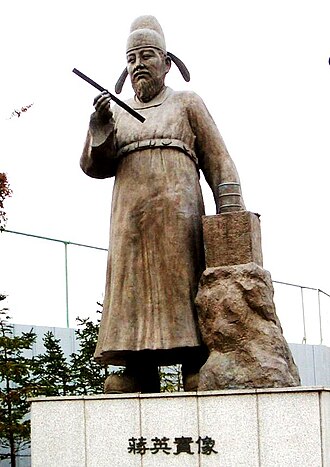
“A man of low birth, yet of genius surpassing all others in the realm — his hands shaped the very instruments by which we measure heaven and earth.”
In the long arc of Korean history, few figures are as remarkable — or as improbable — as Jang Yeongshil (장영실, also romanized as Chang Yŏngsil). Born into slavery during the early Joseon dynasty, he rose through the patronage of King Sejong the Great to become the most celebrated scientist and inventor of medieval Korea. His creations — water clocks, rain gauges, and astronomical instruments — did not merely serve the royal court. They helped define a new era of Korean scientific achievement, one that placed the peninsula at the forefront of East Asian technological innovation during the fifteenth century.
Yet despite his extraordinary contributions, Jang Yeongshil remains far less known to international audiences than his achievements deserve. This article explores his life, his inventions, and the remarkable circumstances that allowed a man of the lowest social standing to leave one of the highest marks on Korean history.
Quick Facts: Jang Yeongshil at a Glance
| Korean Name | 장영실 (張英實) |
| Era | Early Joseon dynasty, 15th century |
| Clan Origin | Asan Jang clan |
| Social Status at Birth | Government slave (gwanno) |
| Royal Patron | King Sejong the Great (r. 1418–1450) |
| Key Inventions | Cheugugi (rain gauge), Jagyeokru (self-striking water clock), Honcheonui (armillary sphere) |
| Dates | Exact birth and death dates unknown; active c. 1400s–1440s |
A Slave Who Outshone the Scholars: How Did Jang Yeongshil Rise So High?
The Joseon dynasty operated under a strict social hierarchy known as the bone-rank system’s successor — the bone of the yangban aristocracy sat at the top, while slaves, or nobi, occupied the lowest rung. For a government slave, or gwanno, advancement within the official bureaucracy was not simply difficult — it was, by law, nearly impossible. That Jang Yeongshil not only escaped this station but was granted an official government rank is one of the most extraordinary social reversals in Korean dynastic history.
Jang Yeongshil was born in Dongnae (present-day Busan) during the late Goryeo or very early Joseon period. His mother was a government slave and, according to the conventions of the time, this meant Jang himself inherited slave status regardless of his father’s background. From an early age, however, his mechanical aptitude attracted attention. Local officials recognized that his ability to repair and construct complex devices was exceptional, and word of his talents eventually reached the royal court in Hanseong (modern Seoul).
It was King Taejong, Sejong’s father, who first brought Jang to the capital. But it was King Sejong — a ruler deeply committed to science, scholarship, and the welfare of his people — who truly elevated him. Sejong famously argued before his court that talent should not be wasted simply because of the accident of birth. Over the protests of conservative ministers who believed that promoting a slave to official rank violated the natural social order, Sejong granted Jang Yeongshil a position at court and eventually elevated him to the rank of Daeho, a senior official position — an almost unimaginable leap for someone of his origins.
“Talent is a gift from heaven, not from birth. To waste such a gift would be to insult heaven itself.”
3 Inventions That Changed Korean History
1. The Jagyeokru — Korea’s Self-Striking Water Clock
Perhaps Jang Yeongshil’s most celebrated creation was the Jagyeokru (자격루), a sophisticated self-striking water clock completed in 1434. Unlike simpler water clocks that required human attendants to monitor water levels and manually strike bells or drums to mark the hours, the Jagyeokru operated automatically. A series of waterwheel-driven mechanisms caused bronze balls to roll and trip levers, which in turn activated figures that struck bells, gongs, and drums at the correct times of day and night.
The Jagyeokru was installed in Gyeongbok Palace and served as the official timepiece of the Joseon state. Because accurate timekeeping was essential to court rituals, agricultural planning, and astronomical observation, the clock carried enormous practical and symbolic weight. It was not simply a technological wonder — it was an instrument of governance. A reconstruction of the Jagyeokru can be seen today at the National Museum of Korea in Seoul.
2. The Cheugugi — The World’s First Standard Rain Gauge
In 1441, under Jang Yeongshil’s direction, Korea produced the cheugugi (측우기) — widely recognized as the world’s first standardized rain gauge. The instrument consisted of a standardized bronze cylinder into which rainwater collected; officials across the country used identical instruments to measure rainfall and report their findings to the central government in a systematic way.
The significance of this invention can hardly be overstated. Accurate rainfall measurement allowed the Joseon government to better anticipate harvests, plan tax assessments based on agricultural conditions, and prepare for floods or droughts. This was rainfall data collection as an instrument of statecraft — nearly two centuries before similar instruments appeared in Europe. The cheugugi stands as one of Korea’s most important contributions to the history of science.
3. Astronomical Instruments — Reading the Heavens for the People
Jang Yeongshil also played a central role in the development of several astronomical instruments, including the honcheonui (혼천의), an armillary sphere used to track the movements of celestial bodies, and the angbuilgu (앙부일구), a hemispherical sundial. The angbuilgu was notable not only for its precision but for its accessibility: Sejong ordered that the sundials be placed in public spaces so that ordinary people — not just court astronomers — could tell the time.
These instruments were part of a broader royal project to recalibrate Korean astronomy away from total dependence on Chinese astronomical models and toward observations made from the Korean peninsula’s own latitude. In this sense, Jang Yeongshil’s work was not merely scientific — it was also a quiet assertion of Korean intellectual and cultural independence.
Comparing Joseon Scientific Achievement with Contemporary East Asia
| Achievement | Joseon Korea (15th c.) | Ming China (15th c.) | Europe (15th c.) |
|---|---|---|---|
| Standardized Rain Gauge | ✔ 1441 (cheugugi) | Not standardized nationally | Not developed until 17th c. |
| Automated Water Clock | ✔ 1434 (Jagyeokru) | Advanced clepsydra tradition | Mechanical clocks developing |
| Public Sundials | ✔ Angbuilgu placed in public | Primarily court instruments | Church and civic sundials |
| Indigenous Astronomical Calendar | ✔ Adapted for Korean latitude | Source of Chinese models | Gregorian reform still 1582 |
The Fall: A Royal Palanquin and the End of an Era
Jang Yeongshil’s story does not end triumphantly. Around 1442, he was tasked with overseeing the construction of a royal palanquin — a sedan chair — for King Sejong’s use. When the palanquin broke during the king’s journey, Jang Yeongshil was held responsible. The court charged him with negligence, and he was stripped of his rank and flogged. The historical record goes largely silent after this point; neither the date nor the circumstances of his death are known.
For many historians, the episode is a painful reminder of the limits of Joseon social mobility. Even a man of Jang Yeongshil’s genius and royal favor remained vulnerable to the political dynamics of court life and the lingering prejudices of a society that had never fully accepted his elevation. Some scholars suggest that the palanquin incident may have been engineered by political rivals who resented his status. Whatever the truth, the abrupt end to his career stands in stark contrast to the brilliance that preceded it.
And yet, Jang Yeongshil’s legacy proved far more durable than his official standing. The instruments he created continued to serve the Joseon court for generations. The cheugugi design was standardized and distributed throughout the country. The Jagyeokru became an enduring symbol of Joseon scientific ambition. Today, his image appears on the South Korean 10,000 won banknote alongside King Sejong — a pairing that feels entirely appropriate for two figures whose partnership produced some of the most remarkable intellectual achievements in Korean history.
Why Jang Yeongshil Still Matters Today
In modern South Korea, Jang Yeongshil has become something of a national hero — a symbol of the idea that talent and hard work can overcome the circumstances of birth. His story has been adapted into television dramas, children’s books, and educational curricula. A science award bears his name. The city of Busan, near his birthplace of Dongnae, celebrates his legacy.
But beyond the nationalist narrative, Jang Yeongshil’s story raises genuinely universal questions about the relationship between social structure and human potential. How many geniuses have been lost to history because their society refused to recognize them? How different might the trajectory of science and technology have been if the talented had always been given the tools they needed to flourish?
King Sejong’s decision to elevate Jang Yeongshil — to fight his own court for the right to employ a slave as a royal engineer — was a radical act in its time. The instruments that resulted from that decision helped shape the administrative, agricultural, and scientific life of a dynasty that would endure for five centuries. That is a legacy worth remembering.
Continue Exploring
On Korea Through Time
- King Sejong the Great: The Scholar King Who Transformed Korea
- How Hangul Changed Korean Society Forever
- The Joseon Dynasty: Five Centuries of Korea’s Last Royal House
- Gyeongbok Palace: Heart of the Joseon Court