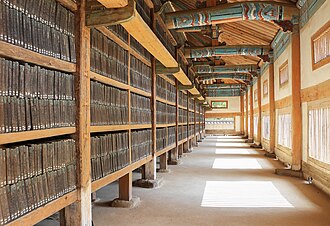
“The Tripitaka Koreana stands as one of the most ambitious intellectual and spiritual undertakings in human history — a nation carving its faith and knowledge into wood, block by block, to survive the storm of invasion.”
Deep in the mountains of South Korea, within the ancient monastery of Haeinsa, rests one of the most extraordinary objects ever created by human hands. The Tripitaka Koreana — known in Korean as Palman Daejanggyeong (팔만대장경), meaning the “Eighty-Thousand Tripitaka” — is a complete collection of Buddhist scriptures carved onto 81,258 wooden printing blocks. Produced during the Goryeo dynasty in the 13th century, this monumental work represents not only a pinnacle of Korean Buddhist scholarship but also a triumph of precision craftsmanship that has endured for over 800 years.
Recognized by UNESCO as a Memory of the World and housed within a complex that is itself a UNESCO World Heritage Site, the Tripitaka Koreana is far more than a religious artifact. It is a window into the soul of a civilization under siege — a people who turned to the power of the dharma when the might of armies failed them.
Quick Facts: The Tripitaka Koreana at a Glance
| Detail | Information |
|---|---|
| Korean Name | Palman Daejanggyeong (팔만대장경) |
| Number of Wooden Blocks | 81,258 |
| Dynasty | Goryeo (고려) |
| Production Period | 1237–1248 CE |
| Location | Haeinsa Temple, South Gyeongsang Province, South Korea |
| UNESCO Status | Memory of the World (inscribed 2007); Haeinsa listed as World Heritage Site (1995) |
| National Treasure | National Treasure No. 32 of South Korea |
| Total Characters | Approximately 52 million |
What Is the Tripitaka, and Why Did Korea Create One?
The word Tripitaka comes from the Sanskrit term meaning “Three Baskets” — referring to the three main collections of Buddhist scripture: the Vinaya (monastic rules), the Sutras (the Buddha’s teachings), and the Abhidharma (philosophical analysis). A complete Tripitaka represents the totality of Buddhist canonical knowledge, and producing one was considered an act of immense religious merit.
Korea’s relationship with Buddhism stretched back to the Three Kingdoms period, when the religion arrived on the peninsula in the 4th century CE. By the time of the Goryeo dynasty (918–1392), Buddhism was deeply woven into the fabric of Korean statecraft and society. Goryeo kings patronized temples, sponsored the translation of texts, and looked to Buddhist ritual as a source of both spiritual and political legitimacy.
The first Korean Tripitaka — now lost — was produced in the early 11th century, reportedly to invoke Buddhist protection against Khitan invasions from the north. This earlier set of blocks was destroyed when the Mongol forces of the Great Khan swept into Korea in the 1230s, burning and pillaging as they advanced. It was in this context of catastrophe and desperation that Goryeo’s leaders commissioned the second — and surviving — Tripitaka Koreana.
Why Did the Goryeo Court Commission the Tripitaka Koreana?
The Mongol invasions of Korea began in 1231 and continued in devastating waves for decades. The Goryeo court, unable to meet the Mongol armies on the battlefield, retreated to Ganghwa Island off the western coast, where they hoped the sea would provide a natural barrier against the horse-mounted invaders. It was from this island refuge that King Gojong and his court authorized the creation of a new, definitive Tripitaka.
The motivation was explicitly religious and political. Goryeo’s leaders believed that the collective merit generated by carving the entire Buddhist canon — perfectly, without error — would invoke the protection of the Buddha and drive away the Mongol armies, just as the first Tripitaka had supposedly helped repel the Khitan. The project was also a statement of cultural resilience: a civilization asserting its spiritual continuity in the face of military collapse.
“Carving the Tripitaka was an act of both faith and defiance — Goryeo’s answer to the Mongol sword was the woodcutter’s chisel and the monk’s unwavering concentration.”
Work began in 1237 and was completed in 1248, an achievement of astonishing speed given the scale of the project. The entire operation was overseen at a scriptorium on Ganghwa Island, with monks and craftsmen laboring over more than eighty thousand individual blocks.
3 Reasons the Tripitaka Koreana Is Considered the World’s Best Buddhist Canon
1. Unmatched Accuracy and Scholarly Rigor
The Tripitaka Koreana is widely regarded by scholars as the most accurate and comprehensive version of the Chinese Buddhist canon in existence. Goryeo’s editorial team — led by the monk Sugi — did not simply copy existing texts. They collated multiple versions of each scripture, including editions from Song China, the earlier Goryeo Tripitaka, and the Khitan canon, noting discrepancies and selecting the most reliable readings. Sugi personally annotated the corrections, leaving behind a scholarly apparatus that allowed later generations to verify the text’s authenticity. In an era before printing standardization, this level of editorial discipline was extraordinary.
2. Extraordinary Craftsmanship and Preservation
Each of the 81,258 wooden blocks measures approximately 70 centimeters in length, 24 centimeters in width, and around 2.6 to 4 centimeters in thickness. The wood used — primarily birch and other hardwoods — was subjected to a meticulous preparation process. Logs were soaked in seawater for several years to prevent cracking and warping, then dried in shade, boiled in salt water, and dried again before carving began. The edges of each block were reinforced with metal corners to prevent damage. The result was a printing medium of remarkable durability. Over 800 years later, the blocks remain in near-perfect condition, still capable of producing legible prints.
3. The Genius of Haeinsa’s Storage Architecture
The survival of the blocks owes as much to architecture as to craftsmanship. The Janggyeong Panjeon — the depositories at Haeinsa Temple where the blocks have been stored since the late 14th century — were designed with an intuitive mastery of natural ventilation and humidity control. The buildings are oriented and fenestrated in such a way that air circulates constantly through the shelving, preventing moisture buildup and mold. The shelves themselves are arranged so that blocks are stored upright, allowing air to pass freely around them. Modern analysis has confirmed that this medieval construction achieves conditions close to those of a climate-controlled archive — without any technology beyond wood, clay, and careful observation of the natural environment.
Comparison: First vs. Second Goryeo Tripitaka
| Feature | First Goryeo Tripitaka (Chojo Daejanggyeong) | Second Goryeo Tripitaka (Tripitaka Koreana) |
|---|---|---|
| Production Period | c. 1011–1087 CE | 1237–1248 CE |
| Reason for Creation | Invoke protection against Khitan invasions | Invoke protection against Mongol invasions |
| Current Status | Destroyed (Mongol invasion, 1230s) | Intact; stored at Haeinsa Temple |
| Editorial Approach | Based primarily on Song Chinese canon | Collated from multiple canons; annotated by monk Sugi |
| Legacy | Historical record only | UNESCO Memory of the World; national treasure |
From Ganghwa Island to Haeinsa: A Long Journey to Safety
After its completion in 1248, the Tripitaka Koreana was initially stored on Ganghwa Island, where it had been created. As the political situation in Korea stabilized following the eventual accommodation with the Mongols and the return of the Goryeo court to the mainland, the question of where to permanently house such a precious collection became pressing. The blocks were transferred to Haeinsa Temple in the Gayasan mountains of present-day South Gyeongsang Province in 1398, during the early Joseon dynasty — a move that removed them from the vulnerable coastline and placed them in the relative security of a mountain monastery.
The choice proved fortuitous. While Korea endured further invasions — most notably the devastating Japanese invasions of 1592–1598 led by Toyotomi Hideyoshi — the Tripitaka Koreana survived. According to historical accounts, Haeinsa itself was threatened during the Imjin War, but the blocks were spared. They have remained at Haeinsa ever since, a continuity of over six centuries in a single location.
The Tripitaka Koreana in the Modern World
Today, the Tripitaka Koreana is recognized globally as one of the supreme achievements of pre-modern Asian civilization. UNESCO inscribed it on the Memory of the World Register in 2007, acknowledging its documentary significance and the remarkable conditions of its preservation. The Janggyeong Panjeon depositories at Haeinsa had already been inscribed as a UNESCO World Heritage Site in 1995, in recognition of the architectural ingenuity that had kept the blocks intact for centuries.
The Korean government designated the Tripitaka Koreana as National Treasure No. 32, and ongoing conservation efforts are managed through collaboration between Haeinsa, government heritage agencies, and academic institutions. In recent decades, a complete digital scan of all 81,258 blocks has been undertaken, ensuring that the text is preserved in digital form and accessible to scholars around the world. Printed copies of the entire canon continue to be made from the original blocks, connecting the present to a tradition of reproduction that stretches back to the 13th century.
For visitors to South Korea, Haeinsa Temple is an accessible and deeply moving destination — a place where history, faith, and craftsmanship converge in a quiet mountain setting. Walking through the Janggyeong Panjeon and standing before the rows of ancient wooden blocks, each one bearing the marks of a medieval craftsman’s chisel, offers a rare encounter with a civilization’s most profound act of collective will.
Continue Exploring
On This Site
- The Goryeo Dynasty: Korea’s Age of Buddhism and Sophistication
- Haeinsa Temple: Guardian of Korea’s Sacred Wooden Library
- The Mongol Invasions of Korea and the Goryeo Resistance
- Buddhism in Korea: From the Three Kingdoms to the Modern Era