A practical guide to Korea’s most beautiful national park: bus routes from Seoul, what the Gwongeumseong cable car involves, which trails suit which walkers, when the leaves turn, and the story of the temple that has stood at the mountain’s foot since the seventh century.
Where the Taebaek range meets the east coast, three hours from Seoul, granite peaks rise almost straight from the sea to nearly two thousand meters. Seoraksan, the “snowy crag mountain,” is the most dramatic landscape in South Korea: needle ridges, sheer rock domes, waterfalls in every valley, and forests that turn red and gold earlier than anywhere else in the country. At its eastern foot, in a wide valley beneath the cliffs, stands Sinheungsa, a temple founded in 652 and rebuilt after every fire and flood since, with a giant bronze Buddha gazing back toward the mountain.
The park is easy to reach without a car, and its most popular area, around Sinheungsa and the cable car, can be enjoyed by anyone regardless of fitness. This guide explains how to get there, how the cable car and trails work, when to go for the foliage that draws the biggest crowds of the year, and the history that ties the mountain to Korean Buddhism.
Why Seoraksan Matters
Korea is a mountainous country, and its mountains have always been sacred ground, home to the spirits of the peaks, to the hermit-scholars who retreated from politics, and above all to the Buddhist monasteries that survived centuries of official disfavor by keeping to the high valleys. Seoraksan holds all of these layers. Its temples, Sinheungsa in the east and Baekdamsa in the west, were founded in the Silla period; its rocks carry legends of dragons and wandering giants; and its trails, cut by generations of monks and pilgrims, are the reason it became Korea’s first UNESCO Biosphere Reserve in 1982.
For visitors, the park combines spectacular scenery with unusual accessibility. From the main entrance, a flat ten-minute walk reaches the temple, a cable car climbs to a ruined mountain fortress with a view over the whole range, and trails of every length fan out into the valleys. In the second and third weeks of October the entire mountainside turns color, and the park receives more visitors than any other in Korea; but even then, ten minutes beyond the cable car, the crowds thin and the mountain is yours.
Quick Facts
| Location | Seoraksan National Park, main entrance at Seorak-dong, Sokcho, Gangwon-do (about 3 hours east of Seoul) |
|---|---|
| Hours | Park trails open from before dawn to sunset (seasonal entry deadlines); cable car roughly 08:30–17:30, later in peak season |
| Admission | Park entry free; former Sinheungsa cultural fee abolished in 2023; parking fee at the main lot; cable car about 15,000 KRW round trip |
| Key Trails | Biryong Falls 2.4 km one way (easy); Biseondae 3 km (easy); Ulsanbawi 3.8 km with 800+ steps (moderate–hard); Daecheongbong summit full day (hard) |
| Best Time | Mid-October for foliage (busiest); May–June for greenery and waterfalls; winter for snow on the crags |
| Website | https://www.knps.or.kr (Korea National Park Service) |
Historical Background
Sinheungsa traces its origin to 652, when the monk Jajang, one of the founding figures of Korean Buddhism who had studied in Tang China, established a temple called Hyangseongsa in the valley beneath the peaks. It burned in 698 and was rebuilt under a new name; it burned again in 1642, and the present Sinheungsa was raised on the site in 1644 by three monks who, according to the temple’s chronicle, were guided to the location in a shared dream. The main hall and the gates of that seventeenth-century rebuilding survive, making Sinheungsa one of the older intact temple complexes in the northern half of the country. Several of its bronze bells and Buddhist paintings are designated treasures.
Seoraksan’s Buddhist geography extends far beyond the main temple. Above Sinheungsa, on a rock shelf reached by a steep trail, the hermitage of Gyejoam is built into a cave, the place where the temple’s founders are said to have meditated. On the western side of the mountain, Baekdamsa, the “temple of a hundred pools,” sits at the head of a long valley and was a retreat for the twentieth-century monk-poet Han Yong-un. Between them, the Bongjeongam hermitage below the summit is the highest in Korea and a pilgrimage destination in its own right. Together these sites explain why the park’s trails feel like a network of paths between sanctuaries rather than a modern recreation area.
The park was designated in 1970, and the Biosphere Reserve status followed in 1982. The giant bronze Buddha that now dominates the approach to Sinheungsa, the Great Unification Buddha, was completed in 1997 at nearly fifteen meters, seated on a lotus pedestal and facing east, and it has become the modern emblem of the mountain. Coreaverse’s history of Korean Buddhism explains the mountain-temple tradition that Seoraksan embodies.
Korea’s Historic Heritage: A Place Through Time -> Korean Buddhism: A 1,700-Year Journey ->
How to Visit
Getting There from Seoul
Seoraksan’s main entrance is at Seorak-dong, on the edge of the coastal city of Sokcho. Express buses leave Seoul Express Bus Terminal and Dong Seoul Terminal for Sokcho throughout the day and take about two and a half hours on the expressway; from Sokcho’s express or intercity terminal, city bus 7 or 7-1 runs past the beaches to the park entrance in about forty minutes, and taxis take twenty. There is no direct rail line yet, though one is under construction. Many operators run day tours from Seoul that include the return transport and, in some cases, a reserved cable car ride, which removes the biggest uncertainty of an autumn visit. Staying a night in Sokcho lets you reach the park at opening, before the day-trippers arrive.
Admission & Hours
The national park is free to enter. For decades visitors paid a cultural heritage fee at the Sinheungsa gate, since the temple owns the land around the entrance, but that charge was abolished nationwide in 2023, and only a parking fee remains at the main lot. Trails open early, before dawn in summer, and entry to the longer routes is cut off in the afternoon at times posted at the trailheads; the park closes at sunset. Certain trails close for fire prevention in late autumn and spring, so check the park website before planning a longer hike.
The Gwongeumseong Cable Car
The cable car climbs from the main entrance area to a station just below Gwongeumseong, a ridge-top site of a medieval mountain fortress, in about five minutes, and from the station a short scramble up bare granite reaches a viewpoint over the whole of Outer Seorak, the sea, and Sokcho. It is the easiest way to see the mountain from above, and consequently the most crowded: tickets are sold for timed slots on a first-come basis, and in October and on weekends the wait for a slot can exceed two or three hours. The strategy is to buy a ticket the moment you arrive, then use the waiting time to visit Sinheungsa or walk to Biryong Falls. The ride costs around 15,000 KRW return.
What to See and Which Trail to Choose
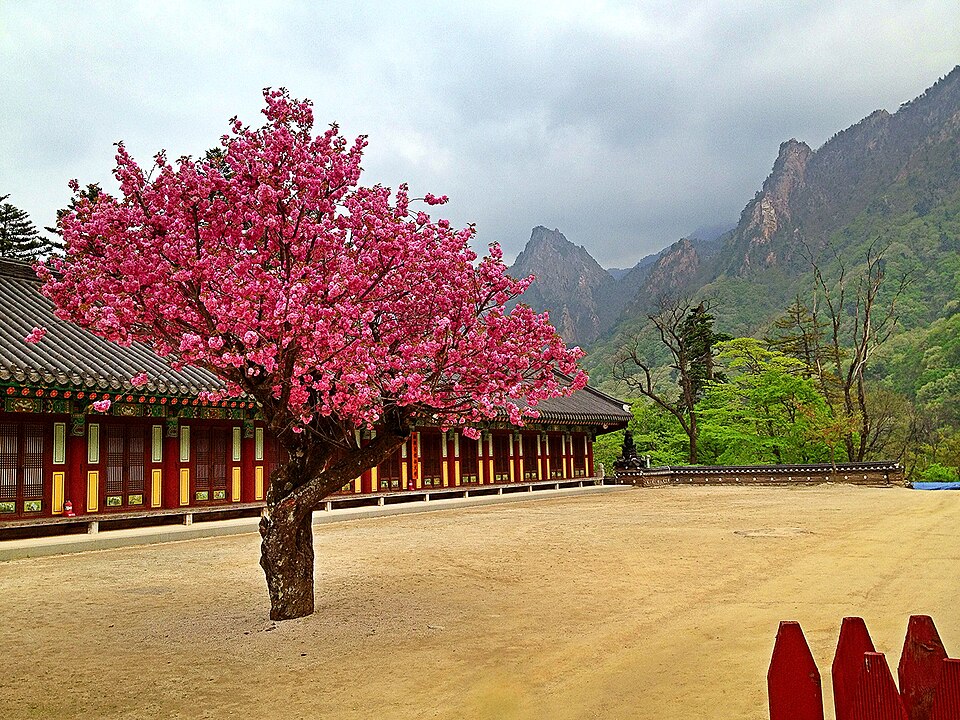
Sinheungsa. Ten minutes’ flat walk from the entrance, past the bronze Buddha, a stone bridge crosses the stream to the temple’s gates and courtyard. The seventeenth-century main hall, the bell pavilion, and the painted gates stand beneath the cliffs, and the setting, with the peaks framed above the roofs, is the finest of any temple in the park. Allow half an hour; the templestay program here offers overnight stays in the valley.
Biryong Falls. The easiest walk in the park: 2.4 kilometers along a stream from the entrance to the “flying dragon” waterfall, with a suspension bridge and, beyond, a steep staircase to a viewpoint over the higher Towangseong Falls. About an hour each way, suitable for all ages.
Biseondae and Geumganggul. A gentle three-kilometer valley walk from Sinheungsa to Biseondae, a broad rock platform in the stream beneath vertical cliffs, where the “fairies ascended” of the name. From here a strenuous side trail climbs to Geumganggul, a cave hermitage in the cliff face. The main path continues deep into the valley toward the summit.
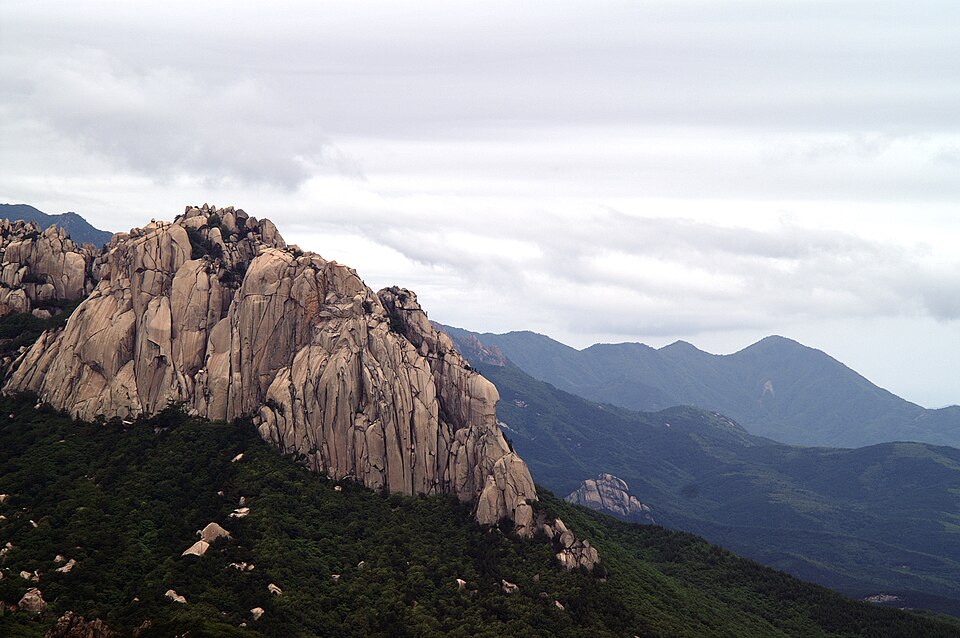
Ulsanbawi. The park’s signature hike: 3.8 kilometers from the entrance, past the temple and the hermitage of Gyejoam with its rocking “wobbly rock,” to the base of a huge wall of granite pinnacles, then up more than eight hundred steel steps bolted to the rock to the top. The climb takes two hours up and ninety minutes down, and the summit view over the ridges and the coast justifies every step. Steep but safe, with railings throughout.
Daecheongbong. The 1,708-meter summit is a full-day undertaking of eight to ten hours from the eastern entrance or from Osaek in the south, with an overnight at a mountain shelter possible by reservation. It is for experienced hikers with proper equipment; in winter the route is closed or restricted.
When to Go
Seoraksan is the first mountain in Korea to turn each autumn. Color begins near the summit in the last days of September and moves down the slopes over the following three weeks, reaching the valleys around Sinheungsa in the middle of October; the national forecast for the mountain is published each September and is worth checking before fixing dates. The peak weeks bring extraordinary crowds, especially at weekends, when buses queue on the approach road and the cable car sells out by mid-morning. Arrive before eight, or come midweek. Spring, from late April, brings azaleas and full waterfalls; summer is green, hot, and prone to afternoon storms; and winter dresses the crags in snow and empties the trails, with the cable car usually running.
Recommended Itinerary
The following plan assumes a night in Sokcho and suits most walkers; the Ulsanbawi climb can be replaced with Biseondae for an easier day.
- Day 1, afternoon – Arrive in Sokcho. Bus from Seoul, check in near the beach or the port, and eat at Daepo Port’s fish market or the famous dakgangjeong fried chicken stalls at Jungang Market.
- Day 2, 07:30 – Park entrance. First bus to Seorak-dong; buy a cable car ticket immediately.
- 08:00 – Sinheungsa. Walk to the temple and the bronze Buddha while the courtyards are quiet.
- 09:00 – Ulsanbawi. Climb via Gyejoam and the steel stairs, about two hours up, ninety minutes back.
- 13:00 – Lunch and cable car. Eat at the restaurants by the entrance, then take your cable car slot to Gwongeumseong for the panorama.
- 15:30 – Biryong Falls. If energy remains, the easy hour-long walk to the waterfall; otherwise return to Sokcho for the sunset at the beach.

Nearby Places & Experiences
Sokcho itself is worth a half day: the fishing port at Daepo, the covered Jungang Market with its fried chicken and squid sundae, and Abai Village, a settlement on a sandbar reached by a hand-pulled cable ferry. Naksansa, twenty minutes south, is a temple on a headland above the sea, famous for its sunrise and its towering white statue of the bodhisattva of compassion, and it runs a templestay. Baekdamsa and the Inner Seorak valleys on the western side of the park are quieter and reached by bus from Sokcho via the Misiryeong tunnel. The beaches of Sokcho and Yangyang, and the surf town of Jukdo, are the region’s summer draw.
Practical Tips
Wear real walking shoes for anything beyond Biryong Falls; the Ulsanbawi steps and the granite around the cable car station are unforgiving in sandals. Carry water and snacks, since there is nothing beyond the entrance area, and a layer for the wind on the ridges even in October. The visitor center at the entrance has English maps and trail conditions. Restrooms are at the entrance, the cable car stations, and Sinheungsa. Mountain weather changes fast; if clouds close in, the cable car may pause, so keep the ticket and be flexible. Leave no trash and stay on the marked trails, which the park enforces strictly.
Frequently Asked Questions
How do I get there from Seoul?
Express bus to Sokcho, about two and a half hours, then city bus 7 or 7-1 to the park entrance, about forty minutes; or a day tour with transport included.
When is the best time for autumn leaves?
The second and third weeks of October in the Sinheungsa area; color begins near the peaks in late September. Check the annual forecast.
Do I need to book the cable car?
Tickets are timed and sold first-come at the base station; buy on arrival and expect long waits in autumn. Some tours include a reserved ride.
Is the park free?
Yes; the former temple gate fee was abolished in 2023. Parking and the cable car are charged separately.
Can beginners hike here?
Yes. Biryong Falls and Biseondae are gentle; Ulsanbawi is steep but safe with railings; Daecheongbong is for experienced hikers.
Continue Exploring
Korea’s Historic Heritage: A Place Through Time -> Korean Buddhism Explained -> Bulguksa: Silla’s Buddhist Masterpiece ->
- 13-seoraksan-ulsanbawi.jpg — Olga Lipunova / CC BY-SA 3.0 / Wikimedia Commons source
- 13-seoraksan-autumn.jpg — Joycekim77 / CC BY-SA 3.0 / Wikimedia Commons source
- 13-seoraksan-sinheungsa.jpg — Flingsun / CC BY-SA 4.0 / Wikimedia Commons source
Disclosure: This article may contain affiliate links. Booking through them supports Coreaverse at no extra cost to you.